Wednesday, November 5, 2008


Obama Victory Speech - Yes, We Can!!!!
Remarks of President-Elect Barack Obama
(as prepared for delivery)
Election Night
Tuesday, November 4th, 2008
Chicago, Illinois
If there is anyone out there who still doubts that America is a place where all things are possible; who still wonders if the dream of our founders is alive in our time; who still questions the power of our democracy, tonight is your answer.
It’s the answer told by lines that stretched around schools and churches in numbers this nation has never seen; by people who waited three hours and four hours, many for the very first time in their lives, because they believed that this time must be different; that their voice could be that difference.
It’s the answer spoken by young and old, rich and poor, Democrat and Republican, black, white, Latino, Asian, Native American, gay, straight, disabled and not disabled – Americans who sent a message to the world that we have never been a collection of Red States and Blue States: we are, and always will be, the United States of America.
It’s the answer that led those who have been told for so long by so many to be cynical, and fearful, and doubtful of what we can achieve to put their hands on the arc of history and bend it once more toward the hope of a better day.
It’s been a long time coming, but tonight, because of what we did on this day, in this election, at this defining moment, change has come to America.
I just received a very gracious call from Senator McCain. He fought long and hard in this campaign, and he’s fought even longer and harder for the country he loves. He has endured sacrifices for America that most of us cannot begin to imagine, and we are better off for the service rendered by this brave and selfless leader. I congratulate him and Governor Palin for all they have achieved, and I look forward to working with them to renew this nation’s promise in the months ahead.
I want to thank my partner in this journey, a man who campaigned from his heart and spoke for the men and women he grew up with on the streets of Scranton and rode with on that train home to Delaware, the Vice President-elect of the United States, Joe Biden.
I would not be standing here tonight without the unyielding support of my best friend for the last sixteen years, the rock of our family and the love of my life, our nation’s next First Lady, Michelle Obama. Sasha and Malia, I love you both so much, and you have earned the new puppy that’s coming with us to the White House. And while she’s no longer with us, I know my grandmother is watching, along with the family that made me who I am. I miss them tonight, and know that my debt to them is beyond measure.
To my campaign manager David Plouffe, my chief strategist David Axelrod, and the best campaign team ever assembled in the history of politics – you made this happen, and I am forever grateful for what you’ve sacrificed to get it done.
But above all, I will never forget who this victory truly belongs to – it belongs to you.
I was never the likeliest candidate for this office. We didn’t start with much money or many endorsements. Our campaign was not hatched in the halls of Washington – it began in the backyards of Des Moines and the living rooms of Concord and the front porches of Charleston.
It was built by working men and women who dug into what little savings they had to give five dollars and ten dollars and twenty dollars to this cause. It grew strength from the young people who rejected the myth of their generation’s apathy; who left their homes and their families for jobs that offered little pay and less sleep; from the not-so-young people who braved the bitter cold and scorching heat to knock on the doors of perfect strangers; from the millions of Americans who volunteered, and organized, and proved that more than two centuries later, a government of the people, by the people and for the people has not perished from this Earth. This is your victory.
I know you didn’t do this just to win an election and I know you didn’t do it for me. You did it because you understand the enormity of the task that lies ahead. For even as we celebrate tonight, we know the challenges that tomorrow will bring are the greatest of our lifetime – two wars, a planet in peril, the worst financial crisis in a century. Even as we stand here tonight, we know there are brave Americans waking up in the deserts of Iraq and the mountains of Afghanistan to risk their lives for us. There are mothers and fathers who will lie awake after their children fall asleep and wonder how they’ll make the mortgage, or pay their doctor’s bills, or save enough for college. There is new energy to harness and new jobs to be created; new schools to build and threats to meet and alliances to repair.
The road ahead will be long. Our climb will be steep. We may not get there in one year or even one term, but America – I have never been more hopeful than I am tonight that we will get there. I promise you – we as a people will get there.
There will be setbacks and false starts. There are many who won’t agree with every decision or policy I make as President, and we know that government can’t solve every problem. But I will always be honest with you about the challenges we face. I will listen to you, especially when we disagree. And above all, I will ask you join in the work of remaking this nation the only way it’s been done in America for two-hundred and twenty-one years – block by block, brick by brick, calloused hand by calloused hand.
What began twenty-one months ago in the depths of winter must not end on this autumn night. This victory alone is not the change we seek – it is only the chance for us to make that change. And that cannot happen if we go back to the way things were. It cannot happen without you.
So let us summon a new spirit of patriotism; of service and responsibility where each of us resolves to pitch in and work harder and look after not only ourselves, but each other. Let us remember that if this financial crisis taught us anything, it’s that we cannot have a thriving Wall Street while Main Street suffers – in this country, we rise or fall as one nation; as one people.
Let us resist the temptation to fall back on the same partisanship and pettiness and immaturity that has poisoned our politics for so long. Let us remember that it was a man from this state who first carried the banner of the Republican Party to the White House – a party founded on the values of self-reliance, individual liberty, and national unity. Those are values we all share, and while the Democratic Party has won a great victory tonight, we do so with a measure of humility and determination to heal the divides that have held back our progress. As Lincoln said to a nation far more divided than ours, “We are not enemies, but friends…though passion may have strained it must not break our bonds of affection.” And to those Americans whose support I have yet to earn – I may not have won your vote, but I hear your voices, I need your help, and I will be your President too.
And to all those watching tonight from beyond our shores, from parliaments and palaces to those who are huddled around radios in the forgotten corners of our world – our stories are singular, but our destiny is shared, and a new dawn of American leadership is at hand. To those who would tear this world down – we will defeat you. To those who seek peace and security – we support you. And to all those who have wondered if America’s beacon still burns as bright – tonight we proved once more that the true strength of our nation comes not from our the might of our arms or the scale of our wealth, but from the enduring power of our ideals: democracy, liberty, opportunity, and unyielding hope.
For that is the true genius of America – that America can change. Our union can be perfected. And what we have already achieved gives us hope for what we can and must achieve tomorrow.
This election had many firsts and many stories that will be told for generations. But one that’s on my mind tonight is about a woman who cast her ballot in Atlanta. She’s a lot like the millions of others who stood in line to make their voice heard in this election except for one thing – Ann Nixon Cooper is 106 years old.
She was born just a generation past slavery; a time when there were no cars on the road or planes in the sky; when someone like her couldn’t vote for two reasons – because she was a woman and because of the color of her skin.
And tonight, I think about all that she’s seen throughout her century in America – the heartache and the hope; the struggle and the progress; the times we were told that we can’t, and the people who pressed on with that American creed: Yes we can.
At a time when women’s voices were silenced and their hopes dismissed, she lived to see them stand up and speak out and reach for the ballot. Yes we can.
When there was despair in the dust bowl and depression across the land, she saw a nation conquer fear itself with a New Deal, new jobs and a new sense of common purpose. Yes we can.
When the bombs fell on our harbor and tyranny threatened the world, she was there to witness a generation rise to greatness and a democracy was saved. Yes we can.
She was there for the buses in Montgomery, the hoses in Birmingham, a bridge in Selma, and a preacher from Atlanta who told a people that “We Shall Overcome.” Yes we can.
A man touched down on the moon, a wall came down in Berlin, a world was connected by our own science and imagination. And this year, in this election, she touched her finger to a screen, and cast her vote, because after 106 years in America, through the best of times and the darkest of hours, she knows how America can change. Yes we can.
America, we have come so far. We have seen so much. But there is so much more to do. So tonight, let us ask ourselves – if our children should live to see the next century; if my daughters should be so lucky to live as long as Ann Nixon Cooper, what change will they see? What progress will we have made?
This is our chance to answer that call. This is our moment. This is our time – to put our people back to work and open doors of opportunity for our kids; to restore prosperity and promote the cause of peace; to reclaim the American Dream and reaffirm that fundamental truth – that out of many, we are one; that while we breathe, we hope, and where we are met with cynicism, and doubt, and those who tell us that we can’t, we will respond with that timeless creed that sums up the spirit of a people:
Yes We Can. Thank you, God bless you, and may God Bless the United States of America.
Wednesday, February 20, 2008
3 Reasons to Vote for Obama from Lawrence Lessig
He states: "He represents the very best of who we are ... character, integrity, ideals ... as someone who opposed the war from the start."
Vote for Barack Obama in 2008!
Monday, February 4, 2008
Monday, January 28, 2008
Excellent blog post on presentation from Jake McKee
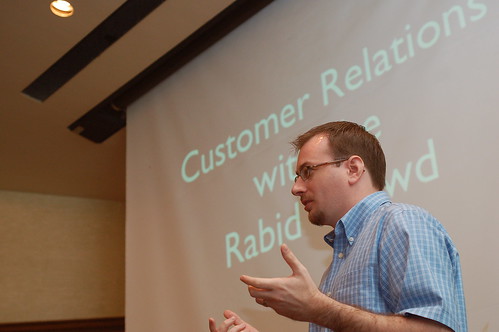
Clearly, this post on his blog belies the comment, “I’m just a n00b at all of this public speaking stuff.” He offers up some sophisticated tips which are very useful to the average business presenter.
His brainstorming and content creation process is quite ingenious:
Typically my presentations, whether client research findings or conference keynote, start on the white board. I start free forming a running list of ideas, thoughts, points, and issues that may be relevant. This includes everything from major points to minor factoids.This idea of whiteboarding, then culling the broader points to index cards is outstanding. Too often, speakers think of their presentation as text and words. This method is a more visual, right-brained, big picture method that is likely to lead to a better organized and well-thought-out structure. It's a very effective and creative way to get started.Jake goes on to add a great suggestion about time:
Once I come across a point that I see as “significant”, I write it down on an index card and lay it on the floor. (I may also thumb through an old stack of cards from an previous session) Pretty soon there’s a bunch of cards laid out on the floor. I take a first pass at culling them down a bit, putting them in some sort of order, and identifying anything that might be missing. I’m a very visual person, so seeing this all laid out in front of me really helps.
No audience likes watching the presenter hurry through the last 15 slides in 2 minutes because they ran out of time. I tend to plan content for no more than 75% of the time allotted, although typically I plan for more like 50% of the time allotted.Throughout the planning process, I’ll develop for that 50% target (i.e. 30 minutes of content for a 1 hour time slot). This helps me to ensure that I’m focusing on the truly important issues, but it also makes it easy to deal with the “oh yeah!” content that pops in during the rest of the development.
He is SO right about ideas coming up later in the process and adding that extra 25%.
I concur completely with Jake's point about clothing: “one step above the audience.” I want to be the best-dressed person in the room but only by a little bit.
He says:
I always try to ensure I’m presenting wearing my wildly comfortable Nike AirMax 360 sneakers.
If you can get away with sneakers, more power to you. I wear either Ecco, Rockport, Cole Haan Air Nike brand dress shoes because they are as comfortable as running shoes but very stylish and acceptable in ANY environment, right up to the boardroom.
He also has some great tips on visual media - images, PowerPoint / Keynote, etc.Terrific post, Jake!
Clinton's Strategy Backfires
The link led me to Peggy Noonan's piece "Declarations" in the Wall Street Journal online.
I once thought highly of Bill Clinton. I think he made a huge mistake in lying to the American people about having sex with Monica Lewinski. His appeal has waned even further in the last couple of weeks. I found the following excerpt rang true for me.
In Dillon, S.C., according to the Associated Press, on Thursday Mr. Clinton "predicted that many voters will be guided mainly by gender and race loyalties" and suggested his wife may lose Saturday's primary because black voters will side with Mr. Obama. Who is raising race as an issue? Bill Clinton knows. It's the press, and Mr. Obama. "Shame on you," Mr. Clinton said to a CNN reporter. The same day the Web site believed to be the backdoor of the Clinton war room unveiled a new name for the senator from Illinois: "Sticky Fingers Obama."
Bill Clinton, with his trembly, red-faced rage, makes John McCain look young. His divisive and destructive daily comportment—this is a former president of the United States—is a civic embarrassment. It is also an education, and there is something heartening in this.
There are many serious and thoughtful liberals and Democrats who support Mr. Obama and John Edwards, and who are seeing Mr. Clinton in a new way and saying so. Here is William Greider in The Nation, the venerable left-liberal magazine. The Clintons are "high minded" on the surface but "smarmily duplicitous underneath, meanwhile jabbing hard at the groin area. They are a slippery pair and come as a package. The nation is at fair risk of getting them back in the White House for four years."
That, again, is from one of the premier liberal journals in the United States. It is exactly what conservatives have been saying for a decade. This may mark a certain coming together of the thoughtful on both sides. The Clintons, uniters at last.
I am reminded of a comment made by David Geffen of Dreamworks SKG (G = Geffen) who is currently supporting Barack Obama for President and raised $1.3 million for his campaign. On February 21, 2007, in an interview with Maureen Dowd of the New York Times, Geffen described Hillary Clinton and Bill Clinton in unflattering terms: "Everybody in politics lies, but they do it with such ease, it's troubling." He said that Hillary Clinton was "incredibly polarizing" and described Bill Clinton as "reckless" and cast doubt on those who say he has become a different person since leaving office.
When I heard this story, I found it a disturbing reminder that Bill Clinton has a thorny relationship with the truth.Bill's credibility has become an issue in Hillary's Campaign. I suspect her campaign sees this as a NIGHTMARE - it is the last thing they want people talking about. This speaks once again to the importance of authenticity and credibility in communication.
Wednesday, January 23, 2008
Bush Legacy: 935 Lies About Iraq
 The Bush administration lied to the American people 935 times in the build-up to the Iraq war, according to a report released by The Center for Public Integrity, a nonprofit, nonpartisan, non-advocacy, independent journalism organization based in Washington, D.C.
"President George W. Bush and seven of his administration's top officials, including Vice President Dick Cheney, National Security Adviser Condoleezza Rice, and Defense Secretary Donald Rumsfeld, made at least 935 false statements in the two years following September 11, 2001, about the national security threat posed by Saddam Hussein's Iraq. Nearly five years after the U.S. invasion of Iraq, an exhaustive examination of the record shows that the statements were part of an orchestrated campaign that effectively galvanized public opinion and, in the process, led the nation to war under decidedly false pretenses ...Ultimately, this will prove to be a big part of the Bush legacy along with a faltering economy, the home mortgage collapse, the disgraceful response to Katrina, a massive $250 billion deficit largely driven by astronomical costs of the Iraq war, election fraud, the scandal surrounding the firing of federal judges and the resignation of another lier Alberto Gonzales (# 1 on Bert Decker's list of Worst Communicators of 2007), and the Valerie Plame / Scooter Libby scandal.
President Bush, for example, made 232 false statements about weapons of mass destruction in Iraq and another 28 false statements about Iraq's links to Al Qaeda. Secretary of State Powell had the second-highest total in the two-year period, with 244 false statements about weapons of mass destruction in Iraq and 10 about Iraq's links to Al Qaeda. Rumsfeld and Fleischer each made 109 false statements, followed by Wolfowitz (with 85), Rice (with 56), Cheney (with 48), and McClellan (with 14)."
These have all led to some of the lowest approval numbers in US history. Bush and Co. have a lot to learn about authenticity and credibility.
Man, I cannot wait until late January, 2009 when this administration is GONE! Good riddance, Dubya!
Strong communication from Shell's CEO Hofmeister
 The speaker was John Hofmeister, CEO & President of Shell Oil Company and the event was titled, "." This appearance was part of a 50 city tour that Hofmeister and other Shell executives have been conducting to start a "dialogue" with the American people.
I was impressed by Hofmeister's candor and willingness to acknowledge the poor reputation that the oil industry is suffering in the media. They are experiencing record profits while gas prices are at their highest levels in history. The public's perception of his company and industry are so poor that he reports receiving a death threat in the mail - a drawing of his body hanging from a tree.
As the event was held in San Francisco, you can imagine that Hofmeister responded to questions about the companies record profits, offshore drilling, conservation, and alternative energies. Hofmeister candid and measured responses sounded both well-informed and balanced - acknowledging the US need for new sources of energy with the long-standing 100 + year dependence on oil and a highly-developed oil-based infrastructure.
I came away thinking that Hofmeister was a very effective communicator and leader. As he speaks about in the interview, Hofmeister earned a bachelor's and master's degrees in political science from Kansas State University. He comes across as erudite. and seems to fully grasp the "big picture" of his industry and is able to articulate it's dynamics extremely well.
His candor typified the qualities of transparency and authenticity that I've written about in many posts here.
You can listen to the recording, see the video or download an MP3 file of that speech at the WAF audio and video archive here.
Tuesday, January 15, 2008
Obama's Concession Speech is Brilliant
Hearing Barack Obama's concession speech after the New Hampshire primary, I was deeply impressed. He is clearly echoing Martin Luther King Jr's great "I Have A Dream" speech by treating adversity as a challenge, inspiring his campaign and supporters to redouble their efforts.
His repetition of a simple phrase "Yes, we can" is a use of a recurring theme that makes his presentation memorable, 'sticky' and very effective. Note the audience picking up the chant ... in spite of the fact that he "lost" the primary, this audience doesn't seem deterred. They seem even more committed to their candidate.
Partial transcript:
This is superb communication and leadership. He uses language that makes the audience feel that they are part of something bigger than themselves, something meaningful, something important and exciting. They are cast as heroes on par with Jefferson, Washington, Louis and Clark, Lincoln, and King. It's heady company and intoxicating to think of one's self as part of a movement.For when we have faced down impossible odds, when we've been told we're not ready or that we shouldn't try or that we can't, generations of Americans have responded with a simple creed that sums up the spirit of a people: Yes, we can. Yes, we can. Yes, we can.
It was a creed written into the founding documents that declared the destiny of a nation: Yes, we can.
It was whispered by slaves and abolitionists as they blazed a trail towards freedom through the darkest of nights: Yes, we can.
It was sung by immigrants as they struck out from distant shores and pioneers who pushed westward against an unforgiving wilderness: Yes, we can.
It was the call of workers who organized, women who reached for the ballot, a president who chose the moon as our new frontier, and a king who took us to the mountaintop and pointed the way to the promised land: Yes, we can, to justice and equality.
Yes, we can, to opportunity and prosperity. Yes, we can heal this nation. Yes, we can repair this world. Yes, we can.
On the macro level, his themes of hope and change have given him a competitive advantage against Hillary Clinton, who many saw as the front runner in this election -- as though it was hers to lose. But I don't hear any consistent message coming from her candidacy other than experience and wonkiness. When Obama speaks about hope and change, it comes across as authentic.
When the Clinton campaign (and all the other campaigns) suddenly picked up on the theme of change after Iowa, it seemed like a lame and inauthentic attempt to hitch themselves to Obama's message, as though it was their own.
Consistently, I find myself deeply moved by his speeches. Though I would think that any of the Democratic or Republican candidates will provide an improvement over the TERRIBLE communication and leadership we suffer from the current administration, no one else inspires like Barack Obama.
Considering the deep hole we are in terms of our economy, our world leadership in science and education, the weakening of the dollar, our current lack of sophisticated understanding of the world's political dynamics, I feel that what we as a nation need right now is a leader who inspires us and who can form relationships with enemies, on the other side of the political aisle and on the other side of the globe. In my view, Barack Obama is that candidate.
It's important to acknowledge Garr Reynolds again for this post from his terrific blog, Presentation Zen. I recommend it highly to all my readers and clients and I encourage you to subscribe.
Tuesday, December 11, 2007
How NOT To Use Powerpoint
I just came across this very funny video on YouTube:
"How NOT To Use Powerpoint By Comedian Don McMillan"
Good advice for anyone who uses PowerPoint.
Thursday, December 6, 2007
Facebook’s nailed it!

There’s been a lot of talk in the media about online social networking tools such as MySpace, LinkedIn, and Facebook.
In my view, Shakespeare predicted MySpace nicely with his line from MacBeth: “full of sound and fury, signifying nothing.”
There is research that indicates that people tend to ignore all data when they are given more than they can process. Recently, neuroscientists tested people for the effects of information overload and found these symptoms:
- Irritation
- Boredom
- Inability to take decisive action
- Pervading sense of “So What?”
- Failure to respond
This is how I felt about MySpace. I found MySpace overwhelming and without meaning.
When I read an article in the February issue of Business 2.0 about LinkedIn, I was excited about the possibilities of LinkedIn and started to use it to link to other business professionals.
After a slow start, the service has nearly doubled its membership during the past year. Seeded with Hoffman's own high-powered network, a magnet for tech's movers and shakers, LinkedIn has capitalized on the Web 2.0 boom to attract more dealmaking members and race past its rivals.
VC heavyweights Sequoia Capital and Greylock - whose hit parade includes Apple, Cisco, Google, and Yahoo - have pumped nearly $15 million into LinkedIn. The private company says it's profitable and on track to hit $100 million in revenue by 2008.
So far, the actual results have been underwhelming. I can’t see how it’s had any significant effect on my business or my relationships with professional contacts.
Then Bill Petro invited me to join Facebook. I’ve known Bill since he took our “iPresentation” workshop at EMC in March of 2002. We’ve since become friends. At first, I thought, “Oh, great – another networking site that won’t live up to it’s billing.” That was followed by the thought: “Bill is a pretty tech-savvy dude. He must see some value. Why not give it a try?”
I signed up and found it easy and pleasant to interact with friends and clients online … but it still didn’t hit me as a ground-breaking application.
I read an article in Wired magazine about Facebook that caught my attention. It was titled: "How Mark Zuckerberg Turned Facebook Into the Web's Hottest Platform."
Today, Zuckerberg, 23, is famous for other reasons. For one thing, analysts think he could be the nation's richest man under 25, with a net worth estimated at $1.5 billion. But more important, he has transformed his company from second-tier social network to full-fledged platform that organizes the entire Internet. As a result, Facebook is the now most buzzed-about company in Silicon Valley, and Zuckerberg is constantly compared to visionaries like Steve Jobs and Bill Gates. Even some of the tech industry's most legendary figures are genuflecting before Zuckerberg. In an entry on his blog, Netscape cofounder Marc Andreessen called Facebook's transformation "an amazing achievement — one of the most significant milestones in the technology industry in this decade." Says Marc Benioff, CEO of Salesforce.com, "I'm in awe."This article caught my attention and raised Facebook's profile on my radar screen. Then, something remarkable happened. I received this Alert from Google: “Serena Software Adopts Facebook as Corporate Intranet."
Serena Software is a client. In fact, I have managed the Serena Software account at The Henderson Group since we started working with them in December of 2003. In addition, I have personally delivered all the workshops we’ve done at Serena in that time frame. We’ve worked with sales, marketing, professional services, and development teams. Consequently, I have a
This struck me as a seminal moment for both Facebook and Serena. Both have received significant press as a result of this announcement.
In the last few weeks, I have found myself having conversations with clients, many from Serena, on a daily basis.
Here’s what I’ve noticed:
- I find myself looking forward to spending time on Facebook much like I enjoy spending time at YouTube or IMDB.com.
- Facebook is the ultimate web mash-up incorporating so many elements of the web into one interface.
For example, videos and photos can be posted on Facebook. Hence, YouTube and photo apps such as Flickr, Yahoo! Photos and Snapfish should be feeling the heat. When I can log into one site and interact with friends and associates, take a look at their photos, blogs, or videos, without having to do another stinking log-in … How cool is that?!? - Conversations with clients take on a MUCH less formal tone because I am hearing about the details of their day. For example, people post their current status such as:
“Terry Gault is enjoying the comfort of home. Aaaah.”
OR
“Dave is contemplating leaving the City...”
This last remark led me to contact this client/friend to learn more about the reasons for leaving and explore if there might be a business opportunity for my wife, RealtorRobin.
Hence, the platform drives a higher level of intimacy and authenticity – a major theme in my work as a communications trainer and coach. - Facebook is the hottest platform for do-it-yourself developers. In this video (from Serena) titled, “Why Facebook?” Tim Zonca brings out some amazing facts:
Facebook allows users to access 7400+ different applications
The most popular apps have 3 million users every day - The traditional marketing methods are no longer necessary to create an audience of users.
The decision to open the Facebook platform to developers has enabled them to create applications that users can easily access in one place and recommend to their friends. Hence, do-it-yourself developers can develop a HUGE audience of users by creating a fun application that spreads through viral word-of-mouth recommendations. Whenever, someone adds an application to their profile, that fact is published to all their friends. Often, these applications (comparing movie tastes on Flickster with Bill Petro, comparing traveler IQ with my nephew, insulting my actor buddies with the Shakespeare Insult Generator) are how the interactions take place on Facebook.
Monday, November 26, 2007
Even a child can do it
I found this video through Garr Reynolds' superb blog, Presentation Zen.
Severn Cullis-Suzuki was only 12 years old in 1992 when she raised money with members of ECO, the Environmental Childrens Organization (a group she founded) to attend the Earth Summit in Rio De Janeiro. Severn presented environmental issues from a youth perspective at the Summit, where she received a standing ovation for a speech to the delegates. This video presents that speech.
What struck me the first time I watched this deeply moving video were the reactions on the faces of the adult delegates. I imagine them as typically distracted and jaded, creatures of politics. When they listen to Severn, their faces are rapt and attentive. Their feelings and thoughts are as evident as neon signs - their protective masks are stripped away by the directness and passion of this terrific young speaker - this "child" who communicates with the wisdom and craft of a veteran speaker.
This video reminded me of one of the deeper truths that I have observed in my work as a presentation skills coach and trainer. Authenticity and passion are the most compelling qualities a presenter can have.
So, what is authenticity? Websters defines it as "true to one's own personality, spirit, or character." I like this quote from Mahatma Gandhi who said, "Happiness is when what you think, what you say, and what you do are in harmony." that is a great description of authenticity, in my estimation. Authenticity is evident when someone is speaking from the heart. David Henderson, my mentor in this work, used to say, "Speak your first truth first."
Passion ("a strong liking or desire for or devotion to some activity, object, or concept") is evident when you give full expression to your deepest desires and feelings.
Severn has both authenticity and passion in spades. She provides a superb and humbling example for all of us.
Saturday, November 24, 2007
Story Corps - A Worthy Project
I can't recall the first time that I heard about Story Corps but I know that the moment I heard about them, I was inspired. Storytelling is a HUGE component of communication. I preach it regularly to all my clients and in all the workshops that I lead. In addition, it's how we share the collective wisdom of our families and communities.
The Story Corps has a website as well as some fun blogs for their mobile trailers, both west and east. There is also StoryCorps Griot - a one-year initiative designed to collect the stories of African Americans. You can find their blog here."Our mission is to honor and celebrate one another’s lives through listening.
Since 2003, almost 30,000 everyday people have shared life stories with family and friends in our StoryBooths. Each conversation is recorded on a free CD to share, and is preserved at the Library of Congress. Millions listen to our broadcasts on public radio and the web. StoryCorps is the largest oral history project of its kind.
Everybody’s story matters. Every life counts. Help us reach out to record our history, hopes, and common humanity—and illuminate the true character of this nation."
NPR.org has posted recordings on their website that you can download as a podcast or hear online from the Story Corps project.
You can order either a CD with recordings or a book titled, "Listening Is an Act of Love" at Amazon. I ordered the CD and am looking forward to listening to it on my next flight. (The spoken word on a MP3 player/iPod is a great way to pass time on planes.)
Tuesday, November 20, 2007
Brain exercise - talking
 Today's local paper contained an article positing a thesis that warmed my heart - talking improves memory and boosts intellectual performance as much as doing crossword puzzles.
"A team led by University of Michigan psychologist Oscar Ybarra asked more than 3,500 people ages 24 to 96 about their social interactions and tested their working memories. Regardless of age, the more social contact, the higher the level of mental function. The researchers also split 76 college students into three groups. One group had a 10-minute discussion, one spent 10 solitary minutes doing intellectual exercises (such as reading comprehension) and the third, in isolation, watched 10 minutes of "Seinfeld." On follow-up cognitive tests, the social interaction and intellectual exercise groups did better than "Seinfeld" viewers. The chit-chatters did just as well as the intellectual group."Check it out:
"Idle chatter? Hardly"
By Susan Brink, Los Angeles Times Staff Writer
November 5, 2007
The next time someone gives you grief for talking too much, reply with, "Hey, I'm giving my brain a workout, baby. Chill!"
Thursday, October 18, 2007
Thursday, August 23, 2007
Urban Word of the Day: nano nap
Are people taking "nano naps" during your meetings or presentations?
Urban Word of the Day
www.urbandictionary.com
August 14, 2007: nano nap
http://www.urbandictionary.com/define.php?term=nano+nap&defid=2345578
An unintentional, seconds-long nap that you take most often in class or a really boring meeting. So short that usually nobody but you notices.
I caught myself taking a nano nap on that conference call
Authenticity in the Face of Crisis
 Harmon makes an important point about effective communication in a time of crisis - that the good of genuine authenticity can often help counter the bad influence of mistakes. He writes:
The 67-year-old Murray was in Montana when he got word of the collapse at the mine owned by Murray Energy Corp. He hopped on a private jet and was at the scene within hours, taking command of the rescue operation, providing the media updates. All this was textbook PR in the best sense. The presence of the concerned chief executive on the scene of a disaster has been understood to be essential to successful crisis management since Exxon's CEO infamously took far too long to travel to Valdez, Alaska, in 1989, to take stock of the oil spill that caused one of history's worst environmental disasters.These would appear to be disastrous mistakes, guaranteeing Murray a shot at The-Worst-PR-Gaffe-of-the-Year-Award. Indeed, the following paints a picture of miner's families who have lost faith in Murray:
But after that, Murray broke so many rules of crisis communications he had news anchors, on-air, asking what they'd just witnessed. From his first briefings, Murray angrily denounced the media (seldom a winning strategy) and blamed union organizers for suggesting that the dangerous practice of "retreat mining" had led to the collapse. He blasted environmentalists for their crusade against global warming, calling it an affront to the coal industry and to the American economy.
Crisis communications experts universally panned Murray's rantings as "callous," "damaging" and "not helpful" to the families of the trapped miners.
Murray also insisted that an earthquake had caused the mine collapse, then doggedly held to that theory despite seismologists' conclusions that the tremors were caused by the collapse.
After three rescuers were killed in a cave-in, Murray dropped out of sight, leaving a subordinate to conduct briefings. A representative for the miners' families said, "We feel Bob Murray has abandoned us." Without any explanation for his disappearance, one could only assume that he was made to understand that his abrasive style did not fit the increasingly grim mood.In spite of all this, Murray is noted in at least one blog for his candor and refreshing authenticity.
"Despite [Murray's] occasional moments of near-insanity, I suspect he's better liked by the general public than he would be if he'd gone by the crisis communication book," David Murray (no relation) wrote on his public relations blog, Shades of Gray.We can recover from mistakes, especially honest ones. But once our credibility comes into question, once our authenticity is compromised, it is a steep uphill-climb to regain the trust of those who experience such a lapse.
In times of crisis, spokespeople should trust in the redeeming power of being authentic. We empathize with the leader who bravely steps up in a time of peril. We readily forgive an unpolished and even shaky presentation -- as long as we feel in our hearts that the spokesperson is being truthful to us, a feeling Bob Murray has not always inspired.
PS: I did a web search to find the Murray Energy corporate website. My search string on Google was "Murray Energy Corporation." On the 10th page of search results, I gave up. The first 10 pages were almost ALL links to news stories or blog posts about the Crandall Canyon mine collapse. This reminded me of the story about Dell in my post about Radical Transparency and Authenticity.
Wednesday, August 22, 2007
Growth or Fixed Mind-Set?
Carol Dweck, a Psychology Professor at Stanford, has written a book titled, "MindSet." She posits that one's mindset is a greater determinant of one's ability to succeed than talent. She outlines 2 different mindsets: The Fixed Mind-Set and the Growth Mind-Set. A fixed mindset is one in which you view your talents and abilities as... well, fixed. In other words, you are who you are, your intelligence and talents are fixed, and your fate is to go through life avoiding challenge and failure. A growth mindset, on the other hand, is one in which you see yourself as fluid, a work in progress. Your fate is one of growth and opportunity.
Here's a terrific Nigel Holmes graphic that originally sparked my imagination. You can also find a recording of an interview with Moira Gunn and Carol Dweck here.
In this press release from Stanford, she recounts a story from the 6th grade:
When psychology Professor Carol Dweck was a sixth-grader at P.S. 153 in Brooklyn, N.Y., she experienced something that made her want to understand why some people view intelligence as a fixed trait while others embrace it as a quality that can be developed and expanded.
Dweck's teacher that year, Mrs. Wilson, seated her students around the room according to their IQ. The girls and boys who didn't have the highest IQ in the class were not allowed to carry the flag during assembly or even wash the blackboard, Dweck said. "She let it be known that IQ for her was the ultimate measure of your intelligence and your character," she said. "So the students who had the best seats were always scared of taking another test and not being at the top anymore."
Asked what seat number Dweck occupied during that memorable year, the professor paused, and silently raised her right index finger. "But it was an uncomfortable thing because you were only as good as your last test score," she said. "I think it had just as negative an effect on the kids at the top [as those at the bottom] who were defining themselves in those terms."
From that experience, Dweck became fascinated with intelligence, convinced that IQ tests are not the only way to measure it. "I also became very interested in coping with setbacks, probably because being in that classroom made me so concerned about not slipping, not failing," she said.
This idea resonated deeply for me. As a trainer, I am constantly interacting with people in a learning environment. I can clearly see behaviors in workshop participants that fall into one category or another.
Also, it parallels the Zen philosophy called Beginner's Mind. Beginner's mind is Zen practice in action. It is the mind that is innocent of preconceptions and expectations, judgments and prejudices. Beginner's mind is just present to explore and observe and see "things as-it-is."
 Shunryu Suzuki-Roshi, author of Zen Mind, Beginner's Mind, captured it very simply with, "In the beginner's mind there are many possibilities, but in the expert's there are few."
Think of how a child approaches life and you will inherently understand beginner's mind. It's full of curiosity and wonder and amazement. "I wonder what this is? I wonder what this means?" Without approaching things with a fixed point of view or a prior judgment, just asking "What is this? What does it mean?"
When I give feedback to workshop participants, those in Fixed (or Expert) Mindset will react by explaining or defending themselves. They feel a strong need to counter any conception that they "made a mistake" by not doing a perfect execution of the task assigned in a given exercise.
Those in Growth (or Beginner's) Mindset react with a sense of humility and confidence. They are genuinely interested in hearing how they might improve their skills. They tend to be thankful for feedback and are quickest to laugh at their own foibles.
Which mindset do you possess? Dweck provides a checklist to assess yourself and shows how a particular mindset can affect all areas of your life, from business to sports and love. The good news, says Dweck, is that mindsets are not set: at any time, you can learn to use a growth mindset to achieve success and happiness
Tuesday, July 31, 2007
To Act or Not to Act - The Climate Change Debate
This video demonstrates that the risk of not acting on climate change FAR outweighs the risk of acting.
http://view.break.com/311805
Wednesday, July 25, 2007
Is our culture failing us?
 “Fifty years ago, I suspect that along with Mickey Mantle, Willie Mays, and Sandy Koufax, most Americans could have named, at the very least, Robert Frost, Carl Sandburg, Arthur Miller, Thornton Wilder, Georgia O'Keeffe, Leonard Bernstein, Leontyne Price, and Frank Lloyd Wright. Not to mention scientists and thinkers like Linus Pauling, Jonas Salk, Rachel Carson, Margaret Mead, and Dr. Alfred Kinsey.”
So said Dana Gioia, chair of the U.S. National Endowment for the Arts, when he delivered the commencement address this month at
“I don't think Americans were smarter then, but American culture was. Even the mass media placed a greater emphasis on presenting a broad range of human achievement.”
He goes on to say:
"Everything now is entertainment. And the purpose of this omnipresent commercial entertainment is to sell us something. American culture has mostly become one vast infomercial. When was the last time you have seen a featured guest on David Letterman or Jay Leno who isn't trying to sell you something? A new movie, a new TV show, a new book, or a new vote?
Don't get me wrong. I love entertainment, and I love the free market. But we must remember that the marketplace does only one thing – it puts a price on everything.
The role of culture, however, must go beyond economics. It is not focused on the price of things, but on their value. And, above all, culture should tell us what is beyond price, including what does not belong in the marketplace.
A culture should also provide some cogent view of the good life beyond mass accumulation. In this respect, our culture is failing us."
This reminded me of an article in Wired Magazine titled "Putin? Never Heard of Her."
"More than a decade after the Internet went mainstream, the world's richest information source hasn't necessarily made its users any more informed. A new study from the Pew Research Center for the People & the Press shows that Americans, on average, are less able to correctly answer questions about current events than they were in 1989. Citizens who call the Internet their primary news source know slightly less than fans of TV and radio news. Hmmm... maybe a little less Perez (sic) Hilton and a little more Jim Lehrer."

- Delivers the lowest quality news coverage.
- Is watched by idiots.
In recent conversations with friends and clients, I have been saying, "Knowledge is no longer a determinant of success. Now, it's ideas."
I say this because Google, Wikipedia and other internet phenomena make your need to know information less critical than your ability to know where to find good, reliable information and come up with creative ideas - creative solutions to problems.
In reflecting on my work with presentation and communication skills with The Henderson Group, I believe that general and broader knowledge of culture is important.
Recently, I was leading a workshop with a group of sales people in the Pacific Northwest. I kept referring to my bibliography, the books that I and my colleague Chuck Kuglen, used in our research, preparing for the workshop. I would ask them, "Have you read The Tao of Sales by E. Thomas Behr ... or ... Selling With Integrity by Sharon Drew Morgen ... or ... Blink by Malcolm Gladwell?
"No."
It became a running joke.
"Would you please stop asking us if we've read any books because we don't read, apparently."
I remember thinking, "These people are sales professionals. Their livelihood depends on being able to do this skill well. I am a trainer. Yes, I do wear a sales hat but 60 - 70% of my livelihood depends on my being an effective trainer. And I've read more books about selling than they have. What's wrong with this picture?"
Perhaps this perspective grew out of my work as an actor and director. When working on a play, I was trained to read biographies of the writer and their other work, not just the play I was working on. In addition, if it was a period piece (Shakespeare, Dickens, Chekhov), I was taught to study the history and the culture of the period. This studious quality seems less prevalent to me now than when I was young.
Is our education system failing us, too? My wife's family is filled with educators that would argue that any alleged failure is certainly not due to the teachers.
Is this a sign that I am fully middle-aged - bitching about how lazy the younger generation seems? It's probably some of the latter.
I consider the stories from Blink of the art experts immediately recognizing a fake Greek sculpture. Their snap judgments prove right because they've spent decades training themselves. This level of bone-deep knowledge doesn't come from a cursory read of a Wikipedia page on Greek sculpture.
In the end, broader understanding of a culture, deep knowledge of culture has some value and perhaps ideas alone aren't enough. Or perhaps the most useful and valuable ideas only flow from minds with a broad understanding of a the culture - be it knowledge of Greek sculpture, theater, or the problems facing businesses.
In closing I think of the words of 2 visionaries:
"Television is democracy at its ugliest." Paddy Chayefsky
"The two most abundant things in the universe are Hydrogren and stupidity.


